Saturday, October 31, 2009

Scared silliness

Happy Halloween

Come into to my web, my sweets, and I will tell you a story.

Every year I carve a pumpkin, sometimes two. I go to a rural pumpkin patch on a day when the sky is bluer than blue and brushed clean of clouds. The air is sharp and dry, electric with the change of season. I stroll through the field, leaning down to pat the firm shells or consider the contours. A few imperfections are intriguing but I don't care for much surface rubble.

Children around me whoop and holler and attempt to carry pumpkins bigger than their own round bellies.

I'm always looking for a special one whose face I see trying to break free of its pumpkin shell. I see where it would smile if I gave it back its mouth and how its eyes would see if I unveiled them.

This year's pumpkin I picked from a supermarket bin--no time for more than a quick once over and home with me it came. When I slid the long stainless steel knife in its top, it felt like butter. I don't remember ever having such a fresh pumpkin. It was young and succulent, its flesh full of juice. I knew its face as soon as my safety razor started drawing, and I quickly revealed it with carving saw and peeler.

Despite where I find my pumpkins, when a candle is lit inside the carved squash, it's magic. And children always know. They stand still in their trick-or-treat tracks and observe the faces as if they are real. But I didn't tell you they aren't, did I?

I wear my witch's black flowing dress, striped stockings and tall hat. I love to cackle. Knock on my door, if you dare.

My snippet today will feature a witch who may find her way into something sometime. She is currently homeless.

An enormous buzzing, an angry rattle and drone, shook the air. A figure shot above the treetops, followed by an undulating black cloud which seemed to be the source of the noise.
Aidan tried to get a better view through the trees and, not paying attention to what was in front of him, walked into a ginormous spiderweb. He swiped the sticky tendrils from his face and hair, hoping the giant spider wasn't there, too.
The figure shot by again and he saw it was a woman sitting on a stick! In her wake was a swarm of hornets.
Aidan hopped over tree roots and rocks as he hurried back to the boulder outcrop where he would have a clear view of the sky. He stumbled up, skinning his hand on a jut of granite but was rewarded when he got to the summit. The witch was spinning in circles, creating a vortex of hornets below her. Her laughter, bright and blade-sharp, competed with the hornet's buzz.
The witch wore swaths of black silk that fluttered like banners. Her legs and feet were bare. Her hair was a tangled, twiggy mass of brown and forest green shades. Aidan thought he saw a bird's nest above her right ear!
And then like a spaceship at hyper speed she shot across the treetops towards a larger rock face several hundred yards from where Aidan crouched. The hornets stuck to her like jet stream, as though she pulled them in her wake, and then Aidan noticed that behind the hornets were a flock of cowbirds, an overalls-clad farmer and a mooing milk cow.
The witch disappeared into a crack in the rock wall, leaving her entourage suspended in air as they buzzed and mooed and shouted. Only her laughter echoed from the rock.


I leave you this fine Halloween with this partying lion.
I start NaNoWriMo at daybreak tomorrow and will keep you updated and slip you some snippets as I go.

Thursday, October 29, 2009

Weaving webs

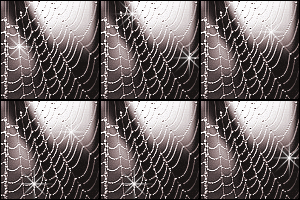
At Talespinning, I celebrate storytelling and the people who weave those tales, so imagine my delight when I found this sparkly web by valoqueen at LiveJournal!
Why do spider webs fascinate me? Consider the orb web, which is constructed by a spider producing sticky silk and first making a rectangular framework. Then she radiates spokes out from the center of the web and finally lays spirals around those spokes. The result is strong and lovely--just like we want our stories to be.
Later, I may post a spooky or silly snippet in honor of Halloween, but, for this moment, I just want to enjoy the pretty sparkly picture. Hope your weaving is going well and that those preparing for NaNoWriMo are gathering all sorts of colorful threads and patterns for the month ahead.

Wednesday, October 28, 2009

Let's go crazy


I may be huffing and puffing like this little steampunky NaNoWriMo badge before November 2009 passes into history. Just in case you've never heard of this event it draws tens of thousands of crazy writers who try to write a 50,000-word novel in one month. Kick-off is Sunday.
Some people succeed and get winner badges (Sorry, folks, no big prize money is at stake). I just want to see what wild story emerges when I spew it forth without the usual noodling and editing.
Because I made this decision at the last minute I didn't do a lot of pre-planning like some NaNo vets. They have outlines and goal schedules. I have a story idea with characters I like and a vague goal. I may end up in Tasmania and you'll have to send someone to fetch me back.
So my blog posts may be sketchy or all about word-count marathons. I'll do my best to stick my head out of the hole and blink at ya. Anyone who wants to buddy me on NaNo can find me under username "sleuthwood." If you're curious, it's from Yeats.

Sunday, October 25, 2009

Laughing at clouds

My day was about pretzel-ing into my sporty but low-slung Miata, extricating myself to pump gas and push a wobbly-wheeled basket through a supermarket. It was all about ho-hum until I took the magical sunset hike.
The sky fairies spun cotton-candy clouds, and I laughed.
Because when I see pink clouds I remember my friend, Kevin, who died too young. After one of his many surgeries he told me that he stood on a wind-whipped cliff and gazed at a pink cloud and laughed in delight. We should always laugh at the gorgeous silliness of our world as if we had bought just one more day.

As I hiked, the sun sunk deeper beyond the horizon and the mountain silhouettes turned slate-gray and then black. Coyotes ripped in high-pitched hysteria from the river bottom. Have you ever noticed how frenzied they sound compared to the haunting howl of wolves?
The sky became so saturated in color that it reminded me of a character I wrote for a story that never got finished. So I'll give him a little spotlight here:


A man appeared with skin the color of rainbows. Around his waist was a belt with hooks that held a clattering skirt of paintbrushes in all sizes and shapes.

"Now that's a sky worthy of Tiepolo or Veronese, although, you know, I taught them how to do it," he said to me.
I was too astonished to ask what he meant.
He dipped a brush into pigment, using himself as a palette. Then he lifted the brush, which grew so long it reached the sky, and he dabbed a swath of coral, hot as the Caribbean across the clouds.
"Where do you get such color?" I asked, finally more curious than awe-struck.
"It's all around! Purples from amethyst, teal from amazonite, emerald-green from diopside. For blues, there is lapis lazuli or azurite. Malachite gives deep green. Did you know I can make superb storm clouds from blue apatite and forests from the green?"
I shook my head, watching his paintbrush gild the edge of a cloud.
"You don't see skies like this too often any more. Mostly, they've faded," he said, his brush hand dropping to his side.
"How can that be? You are painting this one."
"I was drawn by your desire to see the setting sun. There was a time when people honored sunrise and sunset. They held ceremonies. Their shamans chanted. They burned sweet herbs and played music. There was the miracle of a new day and of its close. But now, people barely notice. It's as though they've lost their connection to the cycle of days, to the wonder of it. Nobody cares anymore, and so it is fading."
Okay, that's the snippet. I've got no more. So what do you think--have we lost our sense of wonder? Or are we the ones to keep it alive.

Thursday, October 22, 2009

Batty night thoughts


I saw a bat last night against the dying of the light--a black dart, a zig, a zag, a fluttery flash. Not the owl's deadly glide or a hawk's pinpoint dive, a bat is quick and gone. I felt my breath catch and release, and thought: I saw a bat in the dying of the light.
I walk, most often alone, up a small mountain in my town. Perhaps I should be afraid of some things, but it won't be of bats. Why do bats have such fearsome reputations anyway? Is it our fear of darkness, of things we can't see in the full light of day? They fly at night and often live in caves. Eerie, enough. But does that make them Dracula?
I remember, as a child, being at a neighborhood gathering. It was held in some farm's outbuilding, not used much, I'm guessing. Suddenly, a bat was shooting from corner-to-corner like a pinball in an arcade game. The men dashed after it. The boys hollered. The girls and women covered their heads. Someone told me to do the same or it would get tangled in my hair. Why in the world would it want to do that?
I imagine that a goth girl might adore, not abhor, a bat hat--a swath of black net with a wing spread across her brow. These are the silly-crazy things I think at 2 a.m. when sleep won't bed with me, when the Sandman stands me up.
Poor misunderstood bats. We say people have gone batty or have bats in the belfry to mean they're nuts. Or we chide someone for being blind as a bat when, in fact, bats can see. They have eyes, noses, hands and feet. They also have echolocation, which is using sound waves and resulting echoes to find stuff--from them we learned to use sonar. Bats aren't flying mice like some people describe them. They are closely related to us, these tiny mammals.
Makes me itch all over to consider what would happen to us without them. About 70% of them eat insects, and the brown bat can consume 1,200 night-flying bugs, including mosquitoes, in one hour. At the Carlsbad Caverns in New Mexico, you can watch 400,000 free-tail bats emerge at dusk like an endless black cloud, breaking apart and flapping away. It's not a sight you forget. Before they return at dawn, they will have snapped up tons of bugs. Tons, literally.
Other bats eat fruit and lap flower nectar. Some catch frogs and fish. And there really are vampire bats that suck blood from birds and beasts. Once again, I say, they are not so different from us. Perhaps that's what Dracula is really about.
Do you have a batty story, a tale of bat delight or dread?

Tuesday, October 20, 2009

Sometimes we drool


Here's the thing. Sometimes we talk and write in tired language. Cliche this and that. During revision, one of my goals is to see where I used such line filler as I went dancing merrily on following my story's dangling carrot. I made this sparse word cloud of a few cliches at wordle.net, which you must go toy with if you haven't.
I've been thinking a lot about revision, and was tickled pink (yes, I'm doing this on purpose because actions speak louder than words, ha-ha) to find a great article by Alexander Chee on the way Annie Dillard taught him to write and rewrite. She told her students to triple space between lines to leave space for her to comment, and she always had a lot to say. Among the things Chee discovered was a "museum of cliches in my unconscious."
Chee illustrates how she attacked passive voice, imprecise language, weak verbs, and gives an example of an exercise that I think would blow us all out of the water (sorry, I'll stop doing this). Dillard asked the class to write an essay. Then she told them to take scissors and cut out the best lines. Those were pasted on blank paper. From there: rewrite.
I can see the genius in this. It's not enough to have a few brilliant lines or some great passages if they're strung together with throw-aways. Chee says he learned his voice was trapped and needed to be cut free.
Only by dissecting each line during revision will we not skip over lazy language. Literary agent Nathan Bransford noted a few examples that showed up often in his first-paragraph contest: last thing I expected, consumed with fear and washed over me. I used them to make the word cloud above. Let's play with them but not pad them around our gems.
Have you caught yourself using cliches or been startled by how often people use them in speech?

Friday, October 16, 2009

Clicking my ruby slippers


adrift
anchor-less
cast-off
I wander city streets after dark
and stare in windows of houses
where light is golden and
families gather
tables set for dinner
but I have no home
where I can burst in the door
pull up a chair
for love
Home. A word that is as individual to each of us as our fingerprints.
Charles Dickens wrote in MARTIN CHUZZZLEWIT: Home is a name, a word, it is a strong one; stronger than magician ever spoke, or spirit ever answered to, in the strongest conjuration.
This painting, "No Place Like Home," by Darlene Campbell is a wry commentary on the subject of home. Her oil-and-gold-leaf-on-wood paintings look like religious icons and evoke Renaissance art with their glowing light and heavenly skies. But her images are contemporary, depicting landscapes rapidly altered by development of cookie-cutter neighborhoods and trophy houses. (Note: I shot this photo by placing the painting against wood and didn't get as tight as I should have--the painting ends with the gold leaf.)
The philosopher Gaston Bachelard said, If I were asked to name the chief benefit of the house, I should say: the house shelters day-dreaming, the house protects the dreamer, the house allows one to dream in peace.
I like the notion of a place that protects the dreamer, the writer, the artist--a place that is more than simple shelter or flashy showcase. I'm not sure if I ever really found the home I was searching for, but I believe I have a peaceful place to dream. What about you? How do you define home? It's very late and I'm not sure what I've rambled on about. Here's hoping it makes sense.

Thursday, October 15, 2009

What I carry


I love my nylon shopping bags--strong, durable, lightweight, fun colors. And see how tiny the orange one stuffs into its own pocket? I keep two of them in my purse so I'm never without my own bags for groceries, books or any stray purchase. These even have a clip to attach to a belt. One year I gave them as extra Christmas gifts and created a lot of enthusiasm for taking an easy step to improve our environment--no more plastic bags choking sea turtles, etc.
I mention these today because Bish Denham at RandomThoughts posted a reminder that today is Blog Action Day and the theme is Climate Change. Any change in our behavior that we do and what we post on our blogs raises awareness and maybe will keep us from one of the dystopian worlds some of us imagine in our writing--worlds where mankind screwed up this great planet so bad that only a few survive and have to start civilization over. Hey, we don't want that in reality--for ourselves, our kids or grandkids.

Wednesday, October 14, 2009

Of sand castles and houses made of cards


Like some other blogs I've read today, I wasn't sure what I felt like talking about. But my WIP is on my mind, and there is much still to do in revision. I had taken these photos a month or two back and was thinking of how I don't want my novel to be a castle made of sand, washed away with the next tide. Or like a house built of cards, toppled by a breeze.
I want to write something substantial that withstands whims and trends, that more than one crop of readers might savor and pass along to others.
So how do I accomplish this?
My first thought is universality--a story that speaks to almost anybody by its authentic human experience. Keep it real. Keep it honest. So I guess one needs to read through with a BS meter to strike anything that doesn't ring true. Does anyone have a second-hand BS meter for sale?
Love is important, too. Romantic love, star-crossed lovers, triangles, of course, grab people where it counts. But any form of love that pulls the reader in emotionally creates a long-lasting impression. Create relationships that matter, but make them fragile because love should never be taken for granted.
Resilience and courage. People crave seeing others persevere through tribulation and come out stronger. Despite frailties, give characters nobility and hope. But make them work for it--it shouldn't come easy. Because, well, then we'd all be natural-born heroes, right?
Okay, so maybe this is simplistic. I don't know. I'm kind of Muddle Me today. But if you've ever thought about this, do you have any suggestions for what qualities give a story longevity, make it truly memorable?

Monday, October 12, 2009

What I learned on my vacation

What I learned on my vacation? You can't have a six-month-long summer. I shall explain anon.
This past week was an enormous bouquet from my sister who gave me a week alone at her timeshare condo in Carlsbad, CA.

I wasn't sure whether I would uplug, but when I got there and found I'd left the laptop power cord at home I decided that was a sign.

Without blogging and Internet research, I focused on the task of revising the 100,000 words, give or take, that I had written in the first draft and rewriting of second draft of a YA fantasy. I was prepared with tips from other writers and had shrunk and printed out the manuscript. If you haven't heard of this process, you copy the file and change it to single-space, 10-pt font, which results in an easier-to-handle print version.

Then I read it through--just like a real book, oh my. I used colored post-its to mark scene changes and editing ideas. No stopping to re-write, just jot down that this scene should be deleted or that character's reaction needs to be explored or, uh-oh, I had changed the scene before and now this character is no longer in the picture (make him go away!) or whatever-happened-to-that-amulet-I- mentioned. I felt like a puppeteer controlling a stage full of marionnettes but seeing a pretty good run-through.

I also made a timeline. In the margin of the legal pad, I wrote the passage of days for the corresponding scenes written on the other side of the margin. I found myself noting an awful lot of "next day," which when tallied up led to the shocking realization I had written a six-month-long summer.
Granted, I live in California where we have a six month summer or, some may say, a year-long summer, but my story is in a fictional country where the seasons come and go. So I have some time management issues. Ha. Ha. Really, it won't be that hard to fix now that I'm aware.
My next step is to do the story map chart I learned about from the Literary Lab folks, who give great revision tips. I ran out of time to do all the revision chores I planned but I'm energized to keep the momentum going.
I did make time on this trip for pleasures, such as browsing this wonderful used book store, featuring eclectic and rare volumes.
Besides reading my own manuscript, I read two other YA books and the daily newspaper. And I indulged in "So You Think You Can Dance" and two Netflix DVDs--Sarah Connor Chronicles Season Two with that amazing opening sequence montage and Shirley Manson singing "Samson and Delilah." I confess I watched that opening several times. I also watched the delightful "Lost in Austen," in which a modern woman finds herself smack in the middle of "Pride and Prejudice." Totally funny and romantic.
And last, but way not least, I walked on the beach every day and saw amazing sunsets. And took their pictures with my cool camera phone.
I'm glad to be back, but also grateful to have had as productive and wonderful week as I did.
I missed you all, but in many ways, you were there because of the things I have learned from each of you and the way it is improving my novel-writing skill.
So, a big hello again *waves madly* and thanks.

Sunday, October 4, 2009

Spinning webs and saying adieu


Call me Geek. But I'm excited about this photo. I always wanted a spiderweb for my blog title Talespinning.

Not only does this capture the gigantic spider web in this foggy walk through a park, but I took it on my cell phone! Yes, my new Samsung Propel has a darn fine little camera in it. Who knew?

I used to haul heavy 35mm cameras with extra wide angle and zoom lenses. I had Zeiss, I had Nikon, I had Canon. Then I got my very cool digital Konica Minolta, which has been used for most of the photos I put on this blog. But the cell phone is, like, always in your pocket.

After I got over my excitement on the quality of this phone camera, I discovered I could edit effects on it. Okay, so many of you probably know all about this, but I was in sandbox heaven.


So here are the negative and pastel paint versions. I'm totally giddy.


How. Cool. Is. This?

I may have to put Negative Web back up for Halloween, huh?


Now, for the adieu part. I am going to a seaside retreat and taking my revisions for the WIP with me. Hoping to really accomplish something and get R&R, as well. So I may or may not check for wi-fi and visit the blogosphere. If not, I'll see you next week.


I also want to thank Karen Denise at I'm Always Write for nominating me for the Kreativ Blogger award. It is always an honor to be nominated by another blogger. I "met" Karen when I read a rocking good opener she posted in a WIP contest. I'm putting the award image in the sidebar, since I have received it before. Seven quick things about me:
1) I was born in Paris.
2) I own all the Buffy the Vampire Slayer DVDs and watch them almost as frequently as I eat chocolate--dark, please.
3) I have tons of shoes I never wear but can't part with them--some of them are works of art!
4) I don't remember ever being bookless. There's a photo of me as a toddler holding a book almost as big as me.
5) I love art and have spent some of my hard-earned money on works by contemporary artists. I also always go to museums and galleries when I'm traveling in new cities. Italy is my idea of heaven.
6) My other heaven is any beach. Sand under my feet, waves cresting with the sun turning them green, pelicans flying in formation--ah!
7) I once dreamed I was making a wildly colorful book out of fabric and the pieces of cloth were all fragments of memory. I think that is a mighty fine dream.
Bye until I'm back again. Wishing everyone a most happy and productive week.


Thursday, October 1, 2009

Getting the last word in

This book cover by textile artist Celia Birtwell reminds me of my friend Sarah's family house near Sligo, Ireland. I sat at her paned-window with drawn-back curtain and painted watercolors of Ben Bulben.
But that's for another post, another day.
Today I want to bookend my previous post about great first lines by posting some great last lines. The editors at American Book Review chose 100 Best Last Lines as they did First Lines.
Why is the last line of any import? It is the farewell, and it should be bittersweet.
I'm going to list a few from the Review editors, and as last time I will put the rank they gave it, the line in italics and then the author and title.
#1: ...you must go on, I can't go on, I'll go on.
Samuel Beckett, The Unnamable
#2: Who knows but that, on the lower frequencies, I speak for you?
Ralph Ellison, Invisible Man
#3: So we beat on, boats against the current, borne back ceaselessly into the past.
F. Scott Fitzgerald, The Great Gatsby
#5: But I reckon I got to light out for the territory ahead of the rest, because Aunt Sally she's going to adopt me and sivilize me and I can't stand it. I been there before.
Mark Twain, The Adventures of Huckleberry Finn
#41: I lingered round them, under the benign sky; watched the moths fluttering among the heath, and hare-bells; listened to the soft wind breathing through the grass; and wondered how anyone could ever imagine unquiet slumbers for the sleepers in that quiet earth.
Emily Bronte, Wuthering Heights
To me, these endings leave a lot to imagination. There are futures in them. I want to add a few more that weren't on the Review list. These come from challenged books I loved reading; for more on what challenged books are check out Banned Books Week. Among these is one I've always thought was one of the best endings I'd ever read:
So Lyra and her daemon turned away from the world they were born in, and looked toward the sun, and walked into the sky.
Philip Pullman, The Golden Compass
But they never learned what it was that Mrs Whatsit, Mrs Who, and Mrs Which had to do, for there was a gust of wind, and they were gone.
Madeleine L'Engle, A Wrinkle in Time
Behind him, across vast distances of space and time, from the place he had left, he thought he heard music too. But perhaps it was only an echo.
Lois Lowry, The Giver
Whether this is my end or a new beginning I have no way of knowing: I have given myself over into the hands of strangers, because it can't be helped. And so I step up, into the darkness within; or else the light.
Margaret Atwood, The Handmaid's Tale
Interestingly, the Review chose a final line from The Handmaid's Tale but from the section called Historical Notes after the main story ends. It is: Are there any questions?
How do you feel about the above as ending lines? Do you have one that stuck to you long after you closed the book?

Wednesday, September 30, 2009

The launching pad


Every novel starts somewhere. The author's job is to snag readers with that opening and keep them captivated.
Those first lines should be enticing or arresting. They should evoke the tone of the book, be compatible with the theme and storyline.
In reading through the 100 Best First Lines chosen by the editors of the American Book Review, I picked a few that got my attention. And, by the way, this still being Banned Books Week, a number of these amazing books also make those lists. Go figure.
I considered making this a quiz with the book title and author at the bottom of the post or in the comments section, but, hey, you probably don't want to work that hard. You can test yourself by trying to guess before reading the identity. I'm putting the lines in italics to set them off from the rest of the post and giving the number of where they fell in the 100 Best First Line list.
#3: A screaming comes across the sky.
My immediate reaction to "a screaming," rather than "a scream" and to it coming from "across" the sky is WHAT? WHY? So I'm hooked. The book is Gravity's Rainbow by Thomas Pynchon.
#8: It was a bright cold day in April, and the clocks were striking thirteen.
Thirteen. Need anything more? This one is 1984, George Orwell.
#15: The sun shone, having no alternative, on nothing new.
I love me some ennui. Gotta be Samuel Beckett, Murphy.
#16: If you really want to hear about it, the first thing you'll probably want to know is where I was born, and what my lousy childhood was like, and how my parents were occupied and all before they had me, and all that David Copperfield kind of crap, but I don't feel like going into it, if you want to know the truth.
Um, do I need to tell you? The Catcher in the Rye, J.D. Salinger.
#21: Stately, plump Buck Mulligan came from the stairhead, bearing a bowl of lather on which a mirror and a razor lay crossed.
After this, of course, you may be lost. Ulysses, James Joyce.
#26: 124 was spiteful. Full of a baby's venom.
Spooky, much? Beloved, Toni Morrison.
#38: All this happened, more or less.
A little time shift, anyone? Slaughterhouse-Five, Kurt Vonnegut.
#39: They shoot the white girl first.
Oh, boy. This is a loaded sentence that drags the reader in, despite misgivings. Yes, it's going to be tough and probably brilliant. Paradise, Toni Morrison.
#52: We started dying before the snow, and like the snow, we continued to fall.
Bleak, but beautiful, somehow. I kept reading when I found it years ago. Tracks by Louise Erdrich.
#53: It was a pleasure to burn.
Many of you may know this iconic first line from Ray Bradbury's Fahrenheit 451.
#65: You better not never tell nobody but God.
This is going to be intense, and I want to know why. The Color Purple, Alice Walker.
#96: Time is not a line but a dimension, like the dimension of space.
A chewy thought that you know is going to be explored. Margaret Atwood, Cat's Eye.
#97: He--for there could be no doubt of his sex, though the fashion of the time did something to disguise it--was in the act of slicing at the head of a Moor which swung from the rafters.
Say what? Gotta know more of this strange tale. Orlando, Virginia Woolf
Think your first line has got what it takes? You can share it in the comments section or just drool about the above. I'd love to hear any thoughts on this subject.

Monday, September 28, 2009

Take the challenge and read this book


I don't know if men react to THE HANDMAID'S TALE as women do. Or if anybody experiences what I do. It wounds me and heals me. It terrifies me and comforts me. It astounds me and fortifies me.

It is most extraordinary storytelling told with full writerly skill by prize-winning Canadian author Margaret Atwood.

Take, for instance, some lines early in the book about the ordinariness of the protagonist's life: "We were people who were not in the papers. We lived in the blank white spaces at the edges of print. It gave us more freedom. We lived in the gaps between the stories."

Or this as she throws her body on top of her child's to protect her from the guns of pursuers: "I don't want to smother her, instead I curl myself around her, keeping my hand over her mouth. There's breath and the knocking of my heart, like pounding, at the door of a house at night, where you thought you would be safe."

I shut the book cover last night, after reading the story again, and felt as if I'd been on journey to a place that exists in imagination but has foundation in our world. I had searched my bookshelves for old friends and this one reached out her arms. I am so grateful that I embraced her again.

This is Banned Book Week and I decided to participate through blogging and reading books that have been challenged, a word used to describe an effort by someone in a community to have a book removed from a library or school. Published in 1986, THE HANDMAID'S TALE, was among the 100 most frequently challenged books between 1990-2000.

Like Ray Bradbury's FAHRENHEIT 451, another challenged book, this is a dystopian novel where knowledge and the written word are considered too dangerous for everyday folks like us. And, as in Lois Lowry's THE GIVER, also challenged, a centralized power is in control of all economic and social aspects of the society.

When I picked up Atwood's book to re-read it, I only remembered the most harrowing aspects of the tale, so it was almost like reading a new book. I was swept away with the pace and suspense and totally enamored of the rich language: "I lie in bed, still trembling. You can wet the rim of a glass and run your finger around the rim and it will make a sound. This is what I feel like: this sound of glass. I feel like the word shatter."

The book is most often challenged for sexual reference and for its portrayal of fundamentalist Christian doctrine taken to ultimate extremism. But the sex in the book is sad and horrifying, not titillating or gratuitous. The protagonist is called Offred, her real name taken away, as she is forced to become a handmaid to a Commander and his wife. Her role is to bear children for them as Jacob uses Rachel's maid in Genesis. The ruling fundamentalists think they are creating a better world where women are protected, but, as history has shown repeatedly, absolute power corrupts. What they've created is brutal.

The book doesn't end with a concrete resolution. You are left to imagine what may have been the final fate of this woman. In an epilogue, which Atwood calls Historical Notes, a future conference of academics discuss with aloofness and jest this strange period and the tapes left behind by the woman. As a writer, I was fascinated at the view this discussion gives of Atwood's world building.

This a book to be devoured. And protected. Always.

Friday, September 25, 2009

Adopt a book


We are embarking upon Banned Book Week, and I urge everyone to read a challenged book. Show your support of open-mindedness, your willingness to explore a culture foreign to you, your unending thirst for thought-provoking ideas, even though you may not agree with them.

It is astounding and appalling to see the list of books that were burned, banned or challenged over time and to realize new books are targeted every year. How much less rich in intellect and spirit the world would be without:

HARRY POTTER


THE KITE RUNNER

THE GOLDEN COMPASS

BRIDGE TO TERABITHIA

IN THE NIGHT KITCHEN

THE LORD OF THE RINGS

THE CATCHER IN THE RYE

THE GRAPES OF WRATH

TO KILL A MOCKINGBIRD

THE COLOR PURPLE

BELOVED

LORD OF THE FLIES

OF MICE AND MEN

BRAVE NEW WORLD

SLAUGHTERHOUSE FIVE

I KNOW WHY THE CAGED BIRD SINGS

CATCH-22

The above is just a partial list. The American Library Association lists books challenged by year, as well as information on Banned Book Week, Sept. 26-Oct. 3. Author Laurie Halse Anderson wrote on her blog about challenges to SPEAK and TWISTED and shared part of her thoughtful defense of her books. Her post and the comments section are well worth your time to read.
Also check out the Book Kids interview with E. Lockhart about a challenge to THE BOY BOOK.

Monday, September 21, 2009

Tiny Tale Tuesday, The Netters


The Netters sprang from behind the kelp-shrouded blind and raced sloppily across the mushy sand toward the boy.

It was a rare sighting, and they held their great nets high overhead, each daring to hope she might be the one to snag a boy as a prize.

The last time anyone bagged a boy was when one was caught playing with fat, happy sea cows. But after the Fur Snatchers robbed the sea cows of their pelts, the survivors stopped being happy and went away. The Netters knew where they had gone, but no boys were to be found there.

Flora Net leaped over a slick rock and stubbed her toe, which was soft and pink as a baby's. "Arrgh!"

The boy glanced toward the Netters and jumped higher than Flora ever could.

"Look at him leap! How he flies!" exclaimed Star Net.

"Shut up, Sister, and move your tail. He gets away."

By the time the Netters mastered the rhythm of their limbs and came to where the boy had been, he was gone. Nothing but a small, boyish footprint in the sand, fading as the tide lipped it.

"No one will believe we saw a boy." Flora relaxed her body into the retreating water, let it tug on her hair, as she floated out to sea.

Star joined her, watching the first of her namesakes gleam in the darkening sky.

"Someday, my sister, we will catch a boy. Someday."


Tiny Tale Tuesday is an irregular feature--thanks to blog friend Robyn who suggested I make it so after I last posted a photo with a flash fiction accompaniment. I took this shot as the sun set in San Clemente. And, yes, technically I'm posting this Monday night--blame it on the Netters.

Sunday, September 20, 2009

We all come from somewhere


I am from leaping
into piles of papery leaves
with no concern
for what might lurk.
I am from wandering
in thickety-woods
with salt in my hand
and cider on my tongue--wary of neighborhood ghosts.
I am from icicles
long as swords
and miniature worlds
reflected.
I am from licking thick
maple syrup drizzled
on powdery-pure
fresh snow.
I am from reading
about lost ponies
and making a fence
for a plastic herd.
I am from solemn pledges,
earning badges.
eating s'mores
by campfire.
I am from catching
pink salamanders alone at the creek
and chasing fireflies, who might be fairies,
on summer nights.
I am from skunk weed,
pond water, hanging barns,
rotting porches and
cardinals bright as blood.
I am from girls who
leave others behind
and boys who whisper
forbidden truths.
I am from helping
measure gunpowder into
paper rolls in the secret
stillness of his basement.
I am emerging from innocence but I don't know it yet.
This is a writing prompt used as an exercise, which began with a poem, "Where I'm From" by George Ella Lyon. I got the idea of trying this from author Marilyn Donahue whose new blog, Lines in Time, is full of tips for richer writing.
I chose to recall a two-year-period of my childhood spent in rural Ohio. You can pick anything, any place and mine it.

Thursday, September 17, 2009

Let the rumpus begin


Wander into the children's section of any bookstore these days and you will find Maurice Sendak's WHERE THE WILD THINGS ARE in giant stacks and prominent displays.
It's still a most beloved book even forty-five years after winning the Caldecott Medal. The reason for the current abundance, though, is to sell more books now that a movie is to be released Oct. 16. Director Spike Jonze certainly had to take liberties in order to make a feature-length film out of the simple storyline of a rambunctious boy named Max, who is sent to bed without supper and imagines a world where he becomes king of the wild things.
My favorite line may be: he sailed off through night and day and in and out of weeks and almost over a year to where the wild things are. Oh, and then they roar their terrible roars and gnash their terrible teeth. And Max sends them to bed without supper.
Such magic deserves replay, or, in this case, re-read. I hope anybody with children, grandchildren, nieces, nephews, neighborhood kids or any other available small fry acquires a copy of the book and reads it again or for the first time--before going to the movie.
Any fans of the story and illustrations should check out Cory Godbey's amazing online display of paintings by more than 100 artists inspired by WHERE THE WILD THINGS ARE. The works are scenes from the story reinterpreted by the artists in a variety of styles, everything from whimsical and atmospheric to abstract. This homage is humbling and awesome.
Did you or your kids love this book? I still do.

Wednesday, September 16, 2009

Whose head am I in?


I was merrily reading a book, a sequel I'd gone out of my way to acquire, when suddenly, my sheer enjoyment of the storyline came to a halt, and I went, huh?
I didn't know whose head I was in. A minor character began thinking things, which interrupted my exciting journey with one of the two main characters. It seriously bummed me out.
Point-of-view is a sore point with me, and, yes, I'm using the same word three times in one sentence to make a point. I'm sure everyone knows that POV is the eyes through which we tell our stories. We can write in first, second, third or omniscient POV, but somebody is taking us on the journey. And the reader gets used to knowing who is talking to them. You really don't want to make the reader go, huh?
At the very least, anything that takes a reader out of story may irritate or confuse them. At worst, they may stop reading the book and not buy another by that author. My advice to both aspiring and published authors is to think before you bounce between heads.
Many times when I encounter these rough patches, the POV switch was not necessary. The author may defend it, saying there is no other way to let us know some vital information, but most often that is not true.
In the book I mentioned above the information imparted by the minor character could have been inserted with dialogue and action, thus never upsetting this sensitive reader or leading to this blog rant. And, no, I won't name book or author. First, because I don't want to go that route and, second, because this type of writing can be found everywhere.
I have had this discussion with other writers. Some defend multiple and frequent POV switches, pointing out best-selling authors who do it, and others shrug and say they think it's becoming more popular. At the risk of stretching my neck waaaay out there (I picture some of you sharpening your axes), I think it's lazy writing, an easy way to plop info into the story. And that's how it makes me feel as a reader, like I've been plopped on.
To be clear, I'm not talking about the classic method of presenting different characters' perspectives in alternating chapters. Readers can get their bearings in stories told that way. What I'm describing is being in a scene with a bunch of characters and wondering, "Was that thought Joan's? No, we were just in Joe's head. Oh, is it Jane who's thinking now?"
Trust me. You really don't want to make me go, huh?
The comment section is open. Fire away. I've got my flak jacket on.

Monday, September 14, 2009

Pithy poem, pithy prose


ancient sycamore
by the dead stream, standing firm
through the dry season
This really is an ancient tree said to have been growing in Southern California before the Pilgrims landed on the other side of the Americas. It's oldest limbs are hard as stone and held up by man-made concrete blocks, but it still sprouts new limbs and tender leaves.
I love the rootedness of trees, the way they reach deep into the dark depths of earth and up into the brightness of the sky, the way they grow slow and sure and don't need to move to see the world change.
I leave you with this contemplative picture and musings. Short but pithy, I hope. Today and Tuesday are my two critique group meetings and I have writerly rooting and reaching to tend.